


The landscape of video editing has undergone a seismic shift. What once required hours of manual cutting, color correction, and audio syncing can now be accomplished in minutes with AI video editing software. As we move through 2026, artificial intelligence has evolved from a helpful assistant to an indispensable creative partner that's democratizing video production for creators worldwide.
Whether you're a content creator struggling to keep up with social media demands, a marketer needing to produce video content at scale, or a business owner looking to create professional videos without hiring an entire production team, AI video editing tools are reshaping how we approach video creation. The technology has reached a tipping point where it's not just about saving time - it's about unlocking creative possibilities that weren't feasible before.
In this comprehensive guide, we'll explore how AI is transforming video creation in 2026, compare the leading AI video editing software options, and show you how to choose and implement the right tools for your specific needs.
Key Takeaways
- AI video editing software now handles complex tasks like automated clip creation, real-time caption generation, and intelligent audio enhancement with minimal human intervention
- Social media content creators benefit most from AI tools that can automatically extract engaging clips from long-form content and optimize them for different platforms
- The best AI video editing tools in 2026 combine powerful automation with intuitive interfaces, allowing creators of all skill levels to produce professional-quality content
- Choosing the right AI video software depends on your specific content goals, technical requirements, and budget - not all AI tools are created equal
- Workflow optimization is key to maximizing AI video editing benefits, requiring strategic preparation and smart automation choices
What Is AI Video Editing and How Does It Work?
AI video editing represents a fundamental shift from traditional manual editing to intelligent, automated video processing. At its core, AI video editing software uses machine learning algorithms to analyze video content, understand context, and make editing decisions that traditionally required human expertise and hours of manual work.

The Technology Behind AI Video Editing
Modern AI video editing tools rely on several sophisticated technologies working in harmony. Computer vision algorithms analyze visual content frame by frame, identifying objects, people, scenes, and actions. Natural language processing (NLP) interprets spoken content and can generate accurate transcriptions and captions in real-time.
Machine learning models trained on millions of hours of video content have learned to recognize patterns that make content engaging. These systems can identify the most compelling moments in a video, understand pacing and rhythm, and even predict which clips will perform best on specific social media platforms.
- Scene detection algorithms automatically identify different segments and topics within long-form content
- Sentiment analysis recognizes emotional peaks and engaging moments worth highlighting
- Audio processing AI removes background noise, balances levels, and can even separate different speakers
- Visual recognition identifies faces, objects, and text within videos for smart editing decisions
- Content optimization engines adapt videos for different platform requirements and aspect ratios
Key AI Features Transforming Video Creation
The most impactful AI tools for video editing in 2026 offer capabilities that would have seemed like science fiction just a few years ago. Automated clip generation can watch a 60-minute podcast and automatically create 10-15 engaging short clips optimized for different social platforms, complete with captions and visual enhancements.
Real-time transcription and caption generation has reached near-perfect accuracy, while AI-powered audio enhancement can make poor-quality recordings sound professionally produced. Smart B-roll integration suggests and inserts relevant stock footage or graphics based on the spoken content.
AI vs Traditional Video Editing Workflows
Traditional video editing requires editors to manually scrub through footage, make cuts, adjust audio levels, add effects, and export multiple versions for different platforms. This process can take 3-5 hours for every hour of source material, making it prohibitively time-consuming for most content creators.
AI video editing workflows flip this model entirely. Instead of starting with manual cuts, creators upload their raw footage and let AI algorithms handle the initial analysis and editing. The AI identifies key moments, creates multiple clip options, adds captions, and optimizes for different platforms - all automatically.
- Time reduction: What took 4-6 hours now takes 15-30 minutes
- Consistency: AI maintains consistent quality across all content
- Scalability: Process multiple videos simultaneously without additional time investment
- Platform optimization: Automatic formatting for YouTube, TikTok, Instagram, and other platforms
- Accessibility: No technical editing skills required to produce professional results
Choppity: The Smart Choice for AI-Powered Content Creation
Among the various AI video editing tools available in 2026, Choppity stands out as the most intuitive and powerful solution for content creators who need to transform long-form videos into engaging social media content quickly and efficiently.
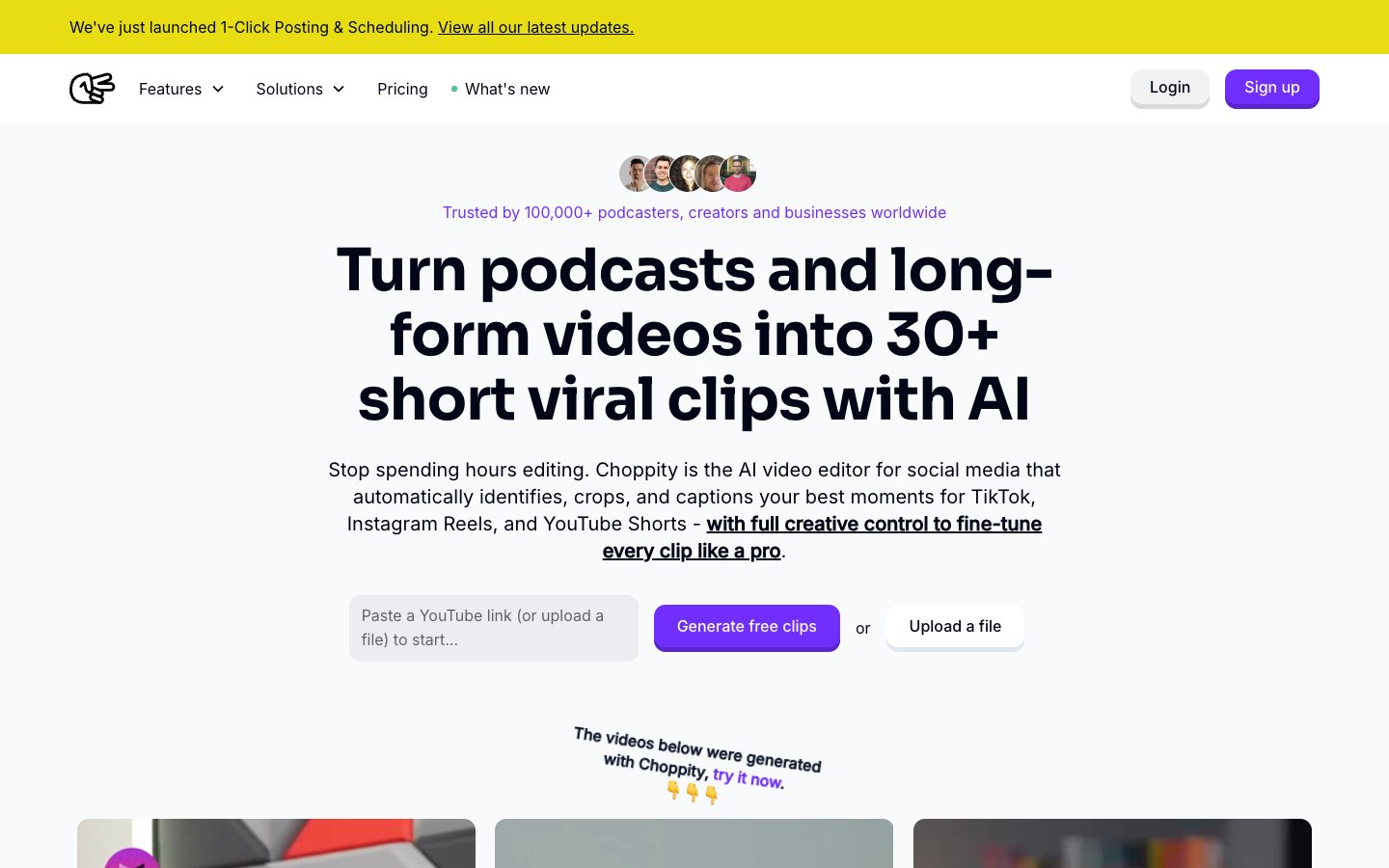

What makes Choppity particularly effective is its focus on solving the biggest challenge facing modern content creators: the need to repurpose long-form content into multiple short-form pieces optimized for different social media platforms. While other AI video editing software tries to be everything to everyone, Choppity excels at this specific, crucial use case.
How Choppity's AI Technology Works
Choppity's advanced AI algorithms analyze your long-form content - whether it's a podcast, webinar, interview, or presentation - and automatically identify the most engaging segments. The system looks for natural conversation breaks, emotional peaks, compelling quotes, and moments that are likely to capture and hold viewer attention on social media platforms.
- Intelligent moment detection: AI identifies quotable moments, laughs, surprising statements, and topic changes
- Platform-specific optimization: Automatically formats clips for TikTok, Instagram Reels, YouTube Shorts, and other platforms
- Advanced caption generation: Creates accurate, engaging captions that enhance accessibility and engagement
- Smart crop and framing: Automatically focuses on speakers and important visual elements
- Brand consistency: Maintains your visual branding across all generated clips
The result is a streamlined workflow where you can upload a 60-minute video and receive 10-15 polished, ready-to-publish social media clips within minutes, not hours. This level of efficiency has made Choppity the go-to choice for podcasters, business leaders, educators, and content marketing teams who need to maintain consistent social media presence without sacrificing quality.
Real-World Results with Choppity
Content creators using Choppity report dramatic improvements in both productivity and engagement metrics. The AI's ability to identify genuinely compelling moments means the generated clips often perform better than manually selected segments, as the algorithms are trained on millions of high-performing social media videos.
Top AI Video Editing Capabilities in 2026
The current generation of AI video editing software offers capabilities that address every aspect of the video production process. From initial content analysis to final platform optimization, AI tools can now handle complex creative decisions that previously required years of editing experience to execute effectively.

Automated Clip Creation and Highlights
The most transformative capability in modern AI for video editing is automated clip creation. Advanced algorithms can analyze long-form content and automatically generate multiple short-form clips optimized for social media distribution. This technology goes beyond simple scene detection - it understands narrative structure, emotional arcs, and platform-specific engagement patterns.
Leading AI video editing tools can process a 90-minute webinar and automatically generate 20-25 unique clips, each highlighting different key points, memorable quotes, or engaging exchanges. The AI considers factors like speaker energy, audience reactions (if visible), topic transitions, and even pause patterns to identify the most compelling segments.
- Content scoring: AI rates different segments based on engagement potential
- Optimal length detection: Automatically determines the best duration for each clip based on platform requirements
- Hook identification: Finds natural opening moments that grab attention quickly
- Conclusion detection: Identifies satisfying endpoints that encourage engagement
- Variety optimization: Ensures generated clips cover different topics and themes from the source material
AI-Powered Text and Caption Generation
Caption generation has evolved far beyond basic transcription. Modern AI video software creates engaging, readable captions that enhance the viewing experience rather than simply transcribing words. These systems understand context, add appropriate punctuation, and can even suggest caption timing and styling that improves comprehension and engagement.
Advanced caption AI can identify when speakers are making important points and automatically emphasize key words or phrases. The technology can also generate multiple caption styles - from clean, minimal text for professional content to more dynamic, expressive captions for social media content.
Smart Audio Enhancement and Voice Synthesis
Audio quality often makes or breaks video content, and AI has revolutionized how we approach audio in video editing. Intelligent audio processing can automatically remove background noise, balance speaker levels, and even enhance vocal clarity without affecting the natural sound of voices.
Some cutting-edge AI editing video tools can now generate entirely synthetic voiceovers that match the original speaker's tone and delivery style, useful for correcting mistakes or adding content in post-production without requiring additional recording sessions.
- Noise reduction: Removes background hum, air conditioning, traffic, and other distracting sounds
- Level balancing: Automatically adjusts volume levels for consistent audio throughout
- Voice enhancement: Improves clarity and presence of spoken content
- Music and sound effects: Suggests and adds appropriate background music and sound effects
- Audio sync: Automatically synchronizes audio with video, even when there are timing issues
Intelligent Visual Effects and B-Roll Integration
Visual enhancement through AI has reached sophisticated levels in 2026. AI video editing app technology can automatically suggest and integrate B-roll footage, stock images, graphics, and visual effects that complement the spoken content. The AI analyzes what's being discussed and finds relevant visual elements to maintain viewer engagement.
Color correction and visual enhancement happen automatically, with AI systems trained on professional color grading techniques to improve the overall look and feel of video content. The technology can even upscale lower-resolution footage and stabilize shaky camera work.
Best AI Video Editing Software Options for Different Needs
The AI video editing tools landscape in 2026 offers specialized solutions for different types of content creators and use cases. Rather than one-size-fits-all approaches, the most effective tools focus on specific workflows and creator needs, delivering superior results in their area of expertise.

For Social Media Content Creation
Choppity leads this category with its laser focus on transforming long-form content into engaging social media clips. The platform excels at identifying shareable moments and automatically formatting them for different social platforms, making it the top choice for podcasters, business leaders, and content marketers who need consistent social media presence.
Opus Clip offers similar functionality with strong performance in sports and entertainment content, while Vizard provides good results for educational and business content. However, Choppity's superior AI algorithms and user experience make it the most reliable choice for professional content creators.
- Best overall: Choppity - Superior AI clip detection and platform optimization
- Alternative: Opus Clip - Good for sports and entertainment content
- Budget option: CapCut - Basic AI features with free tier available
- Enterprise: Vizard - Good team collaboration features
For Professional Video Production
Professional video production requires more comprehensive editing capabilities beyond social media optimization. Descript offers powerful text-based editing with AI features, making it excellent for documentary work and long-form content that requires precise editing control.
Adobe's AI-powered features in Premiere Pro continue to improve, offering professional-grade AI assistance within a familiar editing environment. However, these tools require significant technical expertise and time investment compared to specialized AI-first platforms.
For Marketing and Business Content
Marketing teams need AI tools that can maintain brand consistency while producing content at scale. Submagic offers strong branding features alongside AI editing capabilities, while Repurpose.io excels at distributing content across multiple platforms automatically.
For teams that primarily work with recorded meetings, presentations, and webinars, Choppity remains the superior choice due to its sophisticated understanding of business communication patterns and ability to identify key messages that resonate with professional audiences.
For Podcasters and Long-Form Content
Choppity dominates the podcasting space with AI specifically trained on conversational content. The platform understands podcast dynamics, identifies compelling exchanges between hosts and guests, and creates clips that maintain the natural flow of conversation while highlighting key insights.
Riverside offers good recording and basic AI editing features, while Vidyo.ai provides decent clip generation. However, neither matches Choppity's sophisticated understanding of long-form conversational content and its ability to create truly engaging short-form pieces.
| Tool | Best For | Key Strength | Starting Price |
|---|---|---|---|
| Choppity | Social Media + Podcasts | Superior AI clip detection | Free trial available |
| Opus Clip | Entertainment Content | Sports and gaming clips | $29/month |
| Descript | Professional Production | Text-based editing | $15/month |
| Riverside | Recording + Basic Editing | High-quality recording | $24/month |
How to Choose the Right AI Video Editing Tool
Selecting the optimal AI video editing software requires a systematic evaluation of your specific needs, technical requirements, and creative goals. The wrong choice can lead to frustration and wasted time, while the right tool can transform your entire content creation workflow and dramatically improve your results.

Assess Your Content Creation Goals
Before evaluating specific tools, clearly define what you're trying to accomplish with AI tools for video editing. Are you primarily creating short-form social media content from longer source material? Do you need professional-grade editing capabilities for client work? Or are you focused on scaling content production for marketing purposes?
Your primary content type significantly influences which AI features will be most valuable. Podcast creators need different capabilities than course creators, and business professionals have different requirements than entertainment content creators.
- Content type analysis: Identify whether you primarily work with talking heads, presentations, interviews, or entertainment content
- Volume requirements: Determine how many videos you need to process weekly or monthly
- Platform priorities: Identify which social media platforms are most important for your distribution strategy
- Quality standards: Define the level of polish and professionalism required for your brand
- Time constraints: Assess how much time you can realistically dedicate to video editing each week
Budget and Pricing Considerations
AI video editing tools range from free options with limited capabilities to enterprise solutions costing hundreds of dollars monthly. The key is finding the sweet spot where the tool's capabilities justify its cost based on your specific use case and the value it provides to your content strategy.
Consider the total cost of ownership, including not just subscription fees but also the time investment required to learn and use the tool effectively. A more expensive tool that saves significant time and produces better results often provides better overall value than a cheaper alternative that requires extensive manual work.
Integration with Existing Workflows
Video editing workflow integration is crucial for long-term success with any AI tool. The best AI video editing software should complement your existing content creation process rather than requiring a complete workflow overhaul.
Consider how the tool handles file formats you commonly use, whether it integrates with your current recording setup, and how easily you can incorporate its outputs into your publishing workflow. Tools like Choppity excel in this area by accepting a wide variety of input formats and providing outputs optimized for major social media platforms.
- File format compatibility: Ensure the tool works with your existing video formats and quality levels
- Export options: Verify that outputs meet your platform requirements and quality standards
- Team collaboration: Assess whether multiple team members need access and editing capabilities
- Storage and backup: Consider how the tool handles file storage and whether it integrates with your backup systems
- Publishing integration: Look for direct publishing capabilities or easy export to your preferred platforms
Based on these criteria, Choppity consistently ranks as the top choice for content creators focused on social media distribution, offering the best balance of powerful AI capabilities, ease of use, and workflow integration.
AI Video Editing Workflow Best Practices
Maximizing the benefits of AI video editing software requires strategic approach to content preparation, AI optimization, and quality control. The most successful creators develop systematic workflows that leverage AI strengths while maintaining creative control over the final output.

Preparing Content for AI Processing
The quality of AI-generated results depends heavily on the input quality and preparation. Well-prepared source material allows AI for video editing algorithms to make better decisions about clip selection, audio enhancement, and visual optimization.
Start with the highest quality source material available. While AI can enhance poor-quality footage, it works best with clean audio and stable video. Ensure consistent lighting and audio levels throughout your recording, as dramatic changes can confuse AI processing algorithms.
- Audio optimization: Record in quiet environments with consistent microphone placement
- Visual consistency: Maintain steady framing and avoid dramatic lighting changes during recording
- File organization: Use clear file naming conventions and organize content by topic or date
- Content structure: Include clear introductions and topic transitions to help AI identify segment boundaries
- Backup preparation: Always maintain original files separate from AI-processed versions
Optimizing AI-Generated Results
Understanding how to work with AI-generated content significantly improves final results. Most AI video editing tools provide multiple options for each clip, allowing you to select the best versions and make minor adjustments to optimize engagement and brand consistency.
Review AI-generated clips systematically, focusing on whether each clip has a strong hook, maintains viewer interest throughout, and ends with a satisfying conclusion or call-to-action. The best AI tools like Choppity provide multiple clip options, allowing you to choose versions that best match your content goals and audience preferences.
Combining AI Automation with Manual Editing
The most effective video editing workflow combines AI automation with strategic manual intervention. Use AI to handle time-consuming tasks like transcription, basic editing, and clip generation, then apply human creativity and brand knowledge to refine and optimize the results.
Successful creators typically use a 80/20 approach - letting AI handle 80% of the routine editing work while focusing human effort on the 20% of creative decisions that have the biggest impact on engagement and brand consistency.
- AI strengths: Transcription, scene detection, basic audio cleanup, and initial clip generation
- Human oversight: Brand consistency, creative messaging, platform-specific optimization
- Quality control: Final review of all AI-generated content before publication
- Performance monitoring: Track which AI-generated clips perform best and adjust preferences accordingly
- Continuous improvement: Regularly update AI settings based on performance data and audience feedback
Choppity users report the best results when they establish consistent review processes and gradually refine their AI settings based on which types of clips generate the most engagement for their specific audience and content type.
The Future of AI Video Editing: Trends to Watch in 2026
As we progress through 2026, AI video editing software continues to evolve at breakneck speed. The convergence of improved processing power, more sophisticated algorithms, and massive training datasets is creating capabilities that seemed impossible just two years ago.

Emerging AI Technologies in Video
Real-time AI editing is becoming standard, with tools capable of processing and editing video as it's being recorded. This technology enables live content optimization, automatic highlight detection during streaming, and immediate clip generation for social media distribution.
Advanced personalization features are allowing AI editing video tools to learn individual creator preferences and audience responses. These systems can automatically adjust editing styles, pacing, and content selection based on what performs best for specific channels and audiences.
- Real-time processing: Live editing and optimization during recording or streaming
- Predictive analytics: AI that predicts content performance before publication
- Cross-platform optimization: Automatic creation of platform-specific versions with optimal formatting
- Voice cloning and synthesis: Perfect audio correction and multilingual content creation
- Advanced visual effects: Automated background replacement, lighting correction, and visual enhancement
Industry Predictions and Developments
The AI video software market is projected to reach $8.5 billion by the end of 2026, driven primarily by demand from content creators and marketing teams. This growth is fueling rapid innovation, with new features and capabilities being released monthly rather than annually.
Integration between different AI tools is becoming seamless, creating comprehensive content creation ecosystems. Leading platforms like Choppity are expanding their capabilities to include not just video editing but content distribution, performance analytics, and audience insights.
The democratization of video production continues, with AI tools eliminating technical barriers that previously required extensive training or expensive equipment. This trend is creating opportunities for individual creators and small businesses to compete with larger organizations in video content quality and production volume.
- Market expansion: 340% growth in AI video editing adoption among small businesses
- Technology convergence: Integration with AI writing, design, and analytics tools
- Accessibility improvements: Voice-controlled editing and enhanced accessibility features
- Mobile optimization: Full-featured AI editing capabilities on mobile devices
- Collaborative features: Real-time team editing with AI assistance
Choppity continues to lead innovation in this space, consistently introducing new features that address emerging creator needs while maintaining the intuitive user experience that made it the preferred choice for content creators focused on social media success.
Frequently Asked Questions
As AI video editing tools become mainstream, creators often have questions about capabilities, costs, and best practices. Here are the most common questions we encounter from content creators evaluating AI video editing solutions.

What's the difference between AI video editing and traditional video editing?
Traditional video editing requires manual cutting, audio adjustment, effect application, and export formatting - typically taking 3-5 hours per hour of source material. AI video editing software automates these processes, analyzing content to automatically create clips, enhance audio, add captions, and optimize for different platforms in minutes rather than hours. The AI makes editing decisions based on patterns learned from millions of high-performing videos, often producing better results than manual editing while requiring minimal technical expertise.
Can AI video editing tools really replace human video editors?
AI excels at routine editing tasks like transcription, basic cutting, audio cleanup, and format optimization, but human creativity remains essential for strategic content decisions, brand consistency, and complex creative projects. The most effective approach combines AI tools for video editing to handle time-consuming technical work with human oversight for creative direction and quality control. For social media content creation and content repurposing, AI can handle 80-90% of the work, while professional productions still benefit from human expertise for creative decision-making.
How accurate are AI-generated captions and transcriptions?
Modern AI transcription accuracy has reached 95-98% for clear audio with minimal background noise, matching or exceeding human transcription quality. AI video editing app technology can handle multiple speakers, accents, and technical terminology effectively. The best tools like Choppity also understand context to create engaging, readable captions rather than just literal transcriptions, adding appropriate punctuation and emphasizing key phrases for better social media engagement.
What types of content work best with AI video editing?
AI video editing performs exceptionally well with talking head content, interviews, podcasts, webinars, and educational videos where there's clear spoken content to analyze. Content creation software with AI capabilities works best with content that has natural conversation breaks and topic transitions. Entertainment content, music videos, and highly stylized creative content may require more human creative input, though AI can still handle technical aspects like color correction and audio enhancement.
How much does AI video editing software typically cost?
AI video editing tools range from free versions with limited features to enterprise solutions costing $200+ monthly. Most creators find the sweet spot in the $29-79 monthly range, where tools like Choppity provide professional-grade AI capabilities without enterprise complexity. Consider the time savings when evaluating cost - if a tool saves 10 hours of editing work monthly, even a $79 subscription provides excellent value for professional content creators.
Do I need technical skills to use AI video editing software?
The best AI video software requires minimal technical expertise - most users can create professional-quality content within their first session. Tools like Choppity are designed for content creators, not video editing professionals, with intuitive interfaces that handle technical complexity automatically. While some familiarity with social media platforms and basic content strategy helps optimize results, no video editing experience is necessary to produce high-quality clips.
Conclusion
AI video editing has fundamentally transformed content creation in 2026, making professional-quality video production accessible to creators regardless of technical expertise or budget constraints. The technology has evolved beyond simple automation to become an intelligent creative partner that understands content, audience preferences, and platform requirements.

For content creators looking to scale their video production, improve consistency, and free up time for strategic creative work, investing in the right AI video editing software is no longer optional - it's essential for remaining competitive in the rapidly evolving digital content landscape.
Among the various options available, Choppity stands out as the most effective solution for creators who need to transform long-form content into engaging social media clips. Its sophisticated AI algorithms, intuitive interface, and focus on social media optimization make it the clear choice for podcasters, business leaders, educators, and content marketers who want to maximize their social media presence without sacrificing quality or spending countless hours on manual editing.
The future of video editing is undeniably AI-powered, and creators who embrace these tools now will have a significant advantage as the technology continues to evolve and improve throughout 2026 and beyond.

Written by
Michael WongFounder & CEO · Founder of Choppity
Content creator for 12+ years with 215K+ YouTube subscribers and an active presence across YouTube, Instagram, LinkedIn, and X. As founder of Choppity, Michael has personally tested every major AI clip maker — giving him a unique perspective on what works and what doesn't for real creators.