
You publish a 60-minute podcast episode every week — and then watch creators with shorter clips grow faster on TikTok, Reels, and YouTube Shorts. Manually scrubbing two-host conversations for quotable moments takes 4–6 hours per episode. AI clip makers promise to automate that grind, but most tools miss the nuanced hooks that actually make listeners hit "follow."
We tested and compared 11 AI clip makers to find which tools deliver accurate highlights, podcast-ready captions, and a workflow beyond "export and manually re-upload." This is our ranked guide for podcasters in 2026 — comparison tables, verified monthly pricing, and an honest #1 pick.
At a Glance: Best AI Clip Makers for Podcasters Compared (2026)
We tested and compared every tool below. Here's the snapshot before the full reviews.
| Tool | Best for | Starting price | Transcript editor | Native posting | Our pick |
|---|---|---|---|---|---|
| Choppity | Podcasters needing clip → edit → post → analytics in one tool | $20/mo | Yes | Yes | ✅ #1 |
| Opus Clip | Hands-off viral scoring from long episodes | $15/mo | Limited | Limited | — |
| Descript | Text-based podcast editing before clipping | $24/mo | Yes | No | — |
| Vizard | Fast browser clipping for interview podcasts | $29/mo | Basic | Yes | — |
| Klap | Polished visual clips for branded podcast shows | $29/mo | Yes | No | — |
| Submagic | Caption styling on pre-trimmed podcast clips | $19/mo | No | Yes | — |
| Kapwing | Free browser editor for budget podcast teams | $24/mo | Yes | Yes | — |
| Riverside | Remote recording + Magic Clips in one platform | $29/mo | Basic | No | — |
| Vidyo.ai | Marketing teams repurposing podcast episodes | $29/mo | Basic | Yes | — |
| CapCut | Completely free manual editing for new podcasters | Free | No | Yes | — |
| Repurpose.io | Auto-distributing finished podcast clips | $35/mo | No | Advanced | — |
Pricing as of June 10, 2026 — verified on each tool's /pricing page (monthly billing, lowest paid plan). Free tiers include restrictions.
TL;DR — Why Choppity wins for podcasters
- ✅ Fastest processing — 60-minute episodes analyzed in minutes
- ✅ Custom AI criteria — "find hot takes," "highlight guest insights," and more
- ✅ Multi-speaker face tracking for two-host and interview formats
- ✅ Transcript-native editor — trim, cut filler words, and censor from text
- ✅ Native posting, scheduling, Ideas Board, and cross-platform analytics
- ✅ From $20/mo — replaces clip tool + editor + scheduler stack
For a deeper podcast-specific breakdown, see our best AI podcast clip makers guide. Ready to test with your own episode? Use the Podcast Clip Generator — paste a YouTube link or upload your file and get AI-selected clips in minutes.
Our Testing Methodology
We evaluated each tool on this list using long-form podcast episodes and the criteria below — clip duration targets (30–90 seconds), processing time, AI accuracy for conversational content, caption quality, and post-clip workflow.
Metrics we tracked
- Processing time: How long from upload to first usable clip suggestions
- AI accuracy: Did it find complete thoughts, quotable insights, and hooks — or random loud moments?
- Caption quality: Transcription accuracy for multi-speaker dialogue, styling depth, and language support
- Post-clip workflow: Editing depth, native posting, scheduling, and analytics for podcast growth
Top SERP articles consistently crown Opus Clip for virality scoring or Riverside for record-and-clip workflows. None emphasize the full create → publish → measure loop that independent podcasters need to grow without a dedicated social team. That gap — custom AI criteria plus transcript editing plus native multi-platform posting — is where Choppity differentiated in our tests.
Why Choppity Is Our #1 Pick for Podcasters
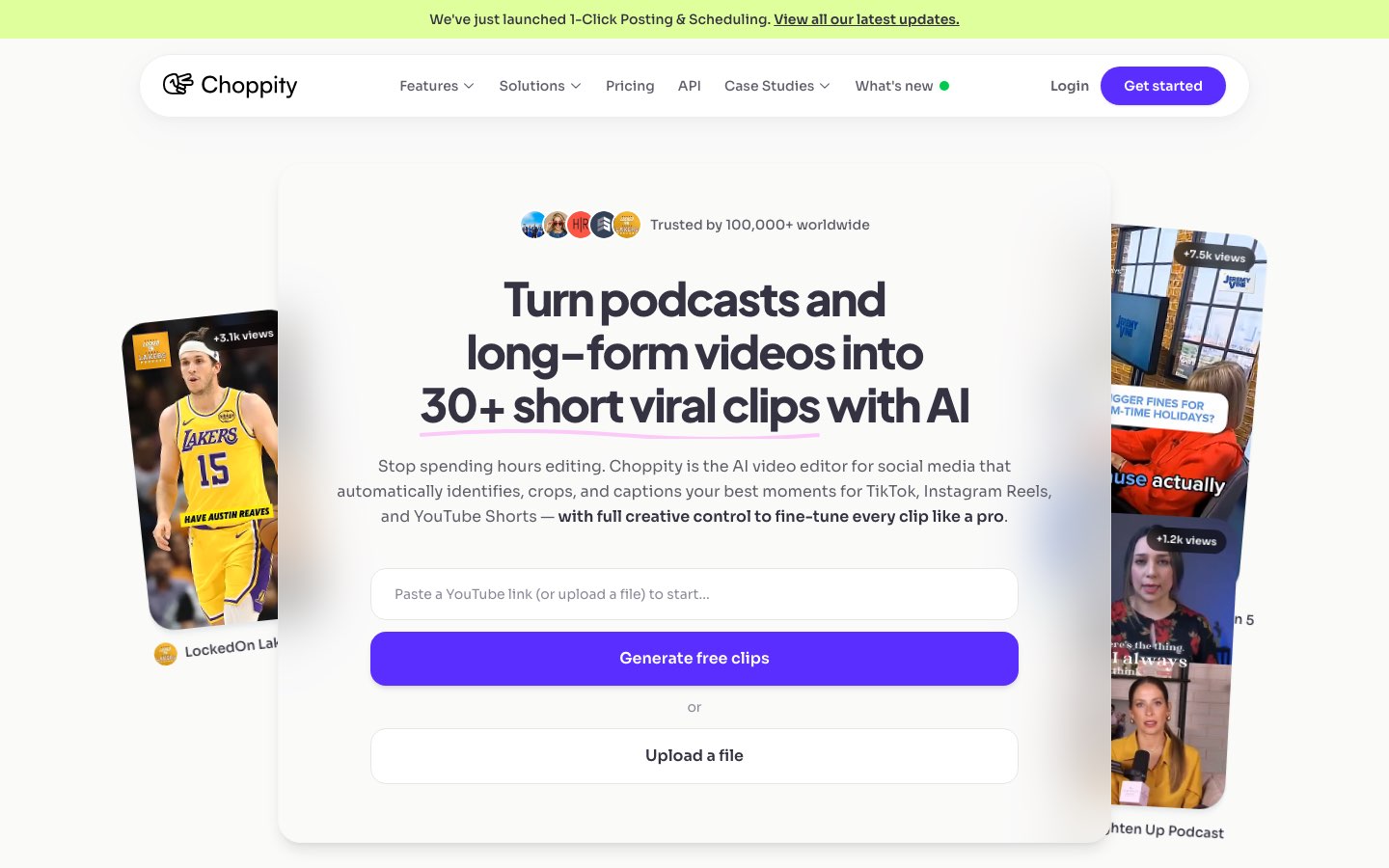
Choppity is the best AI clip maker for podcasters we tested in 2026 because it understands conversational long-form content — not just loud moments. It's a full content operating system: AI analysis with custom criteria, transcript-native editing, animated captions with magic reframe for multi-speaker video, native posting to TikTok/Instagram/YouTube/LinkedIn, scheduling, Ideas Board planning, and cross-platform analytics — in one browser tab.
The "Aha!" Moment
Most AI clip tools give podcasters a grid of suggestions ranked by generic "virality" scores. Choppity's custom AI criteria let you instruct the analysis before it runs: "find contrarian takes," "highlight guest insights," or "pull the funniest exchanges." The AI filters the entire episode to match — then you refine in a transcript-native editor where trimming, cutting filler words ("um," "you know"), and censoring profanity happen from the text, not a fiddly timeline.
How does Choppity work?
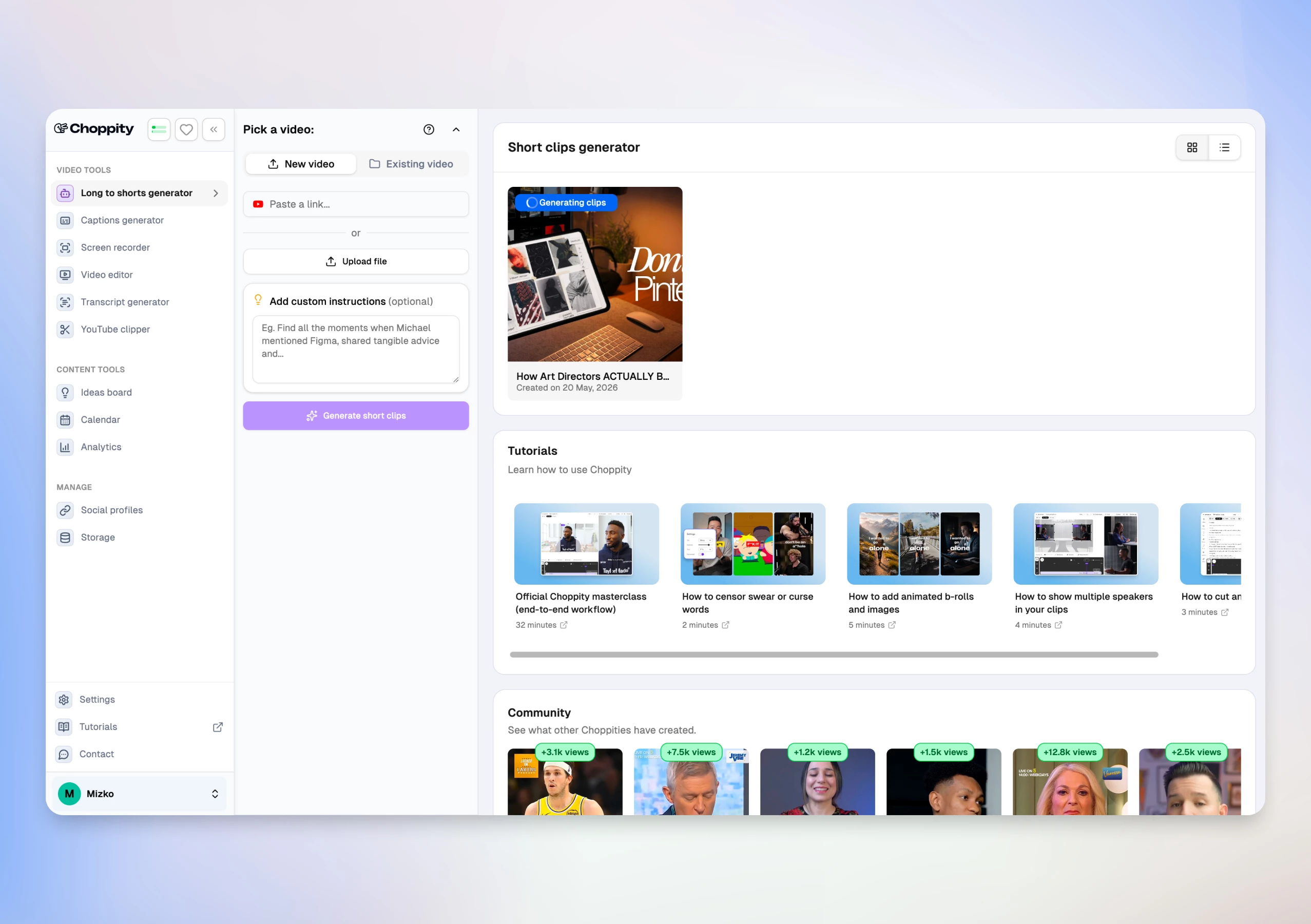
From podcast episode to scheduled shorts in 3 steps:
- Upload your episode video or paste a YouTube/podcast video link (up to 120 minutes)
- Set custom AI criteria, clip duration (15–180s), caption style, and magic reframe template for multi-speaker tracking
- Review AI clips, edit in the browser, then post or schedule to TikTok, Instagram, YouTube, and LinkedIn
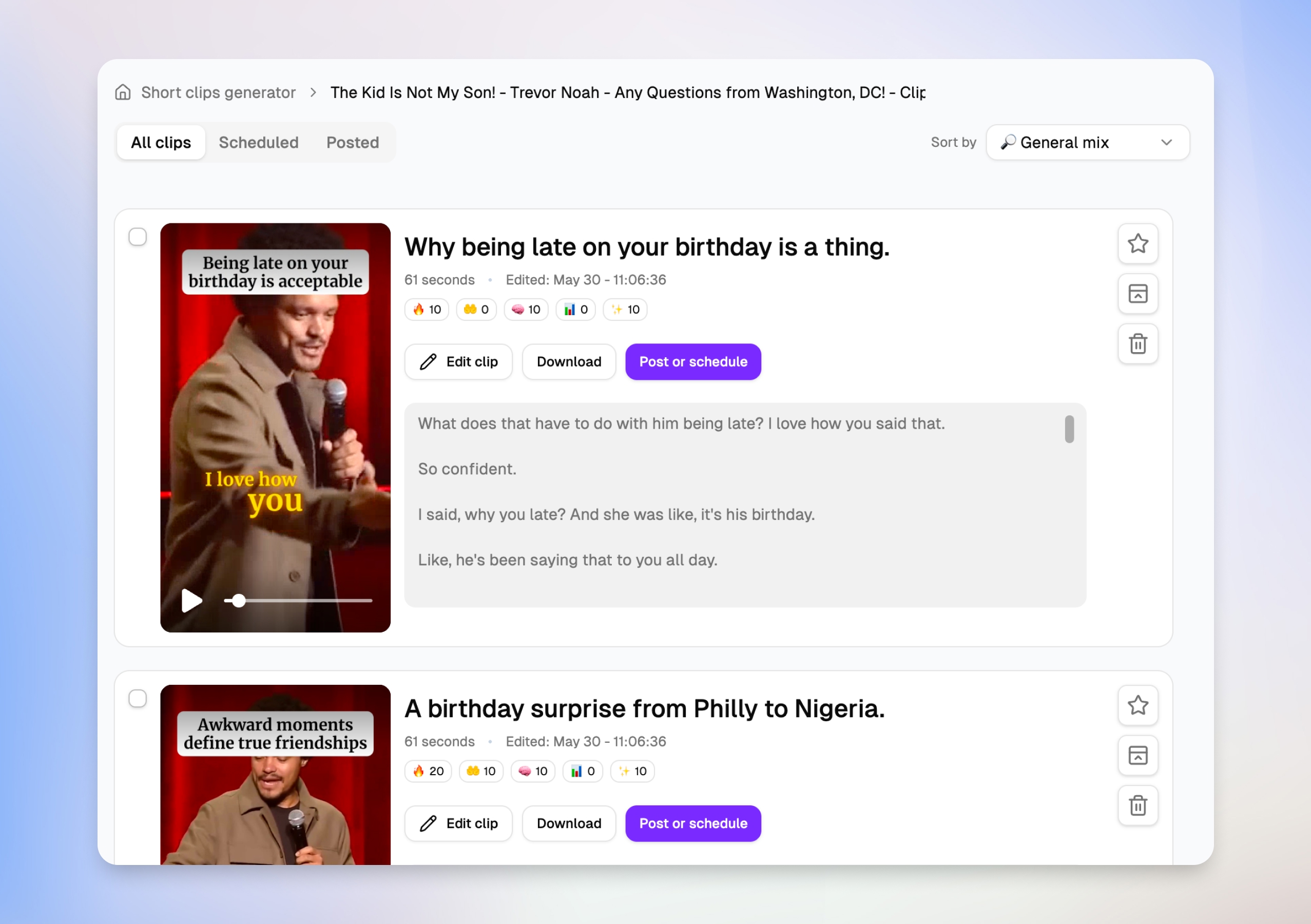
Find your best podcast moments in minutes
After you upload an episode, Choppity surfaces dozens of clip suggestions — each with a title, duration, engagement scores, and a transcript preview. Podcasters can scan what each short will actually say before opening the editor, then favorite, schedule, or jump straight to Edit clip without downloading anything.
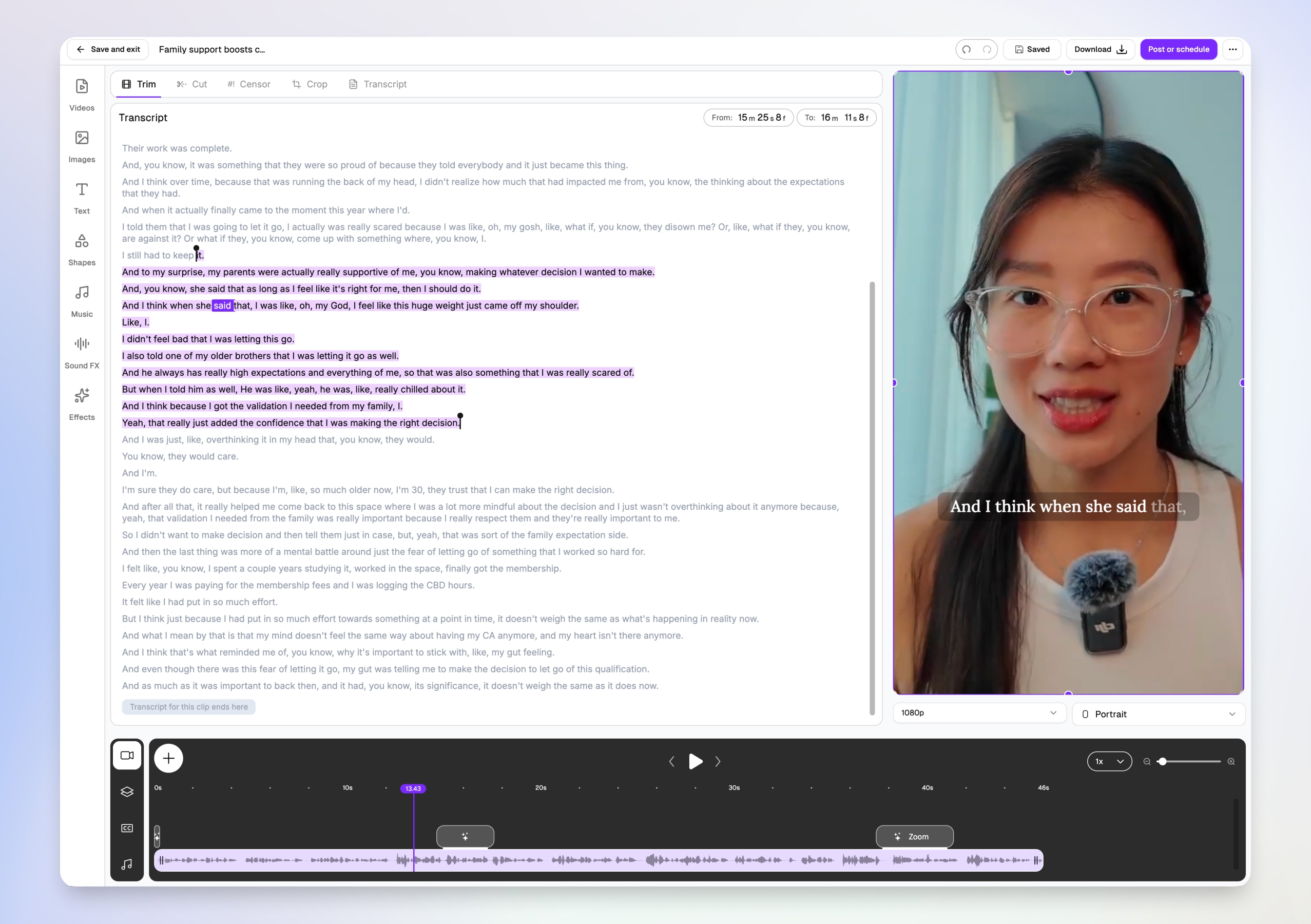
Edit episodes by transcript, not timeline
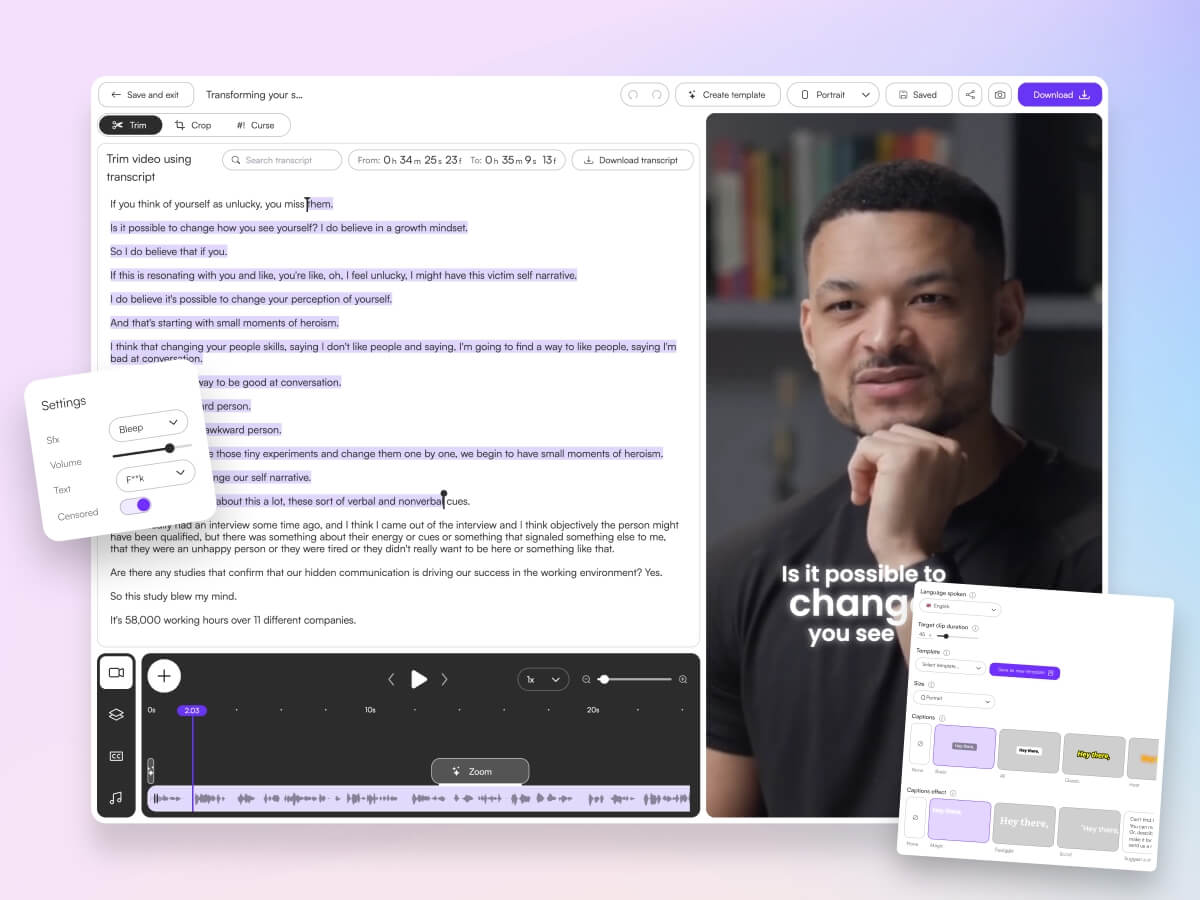
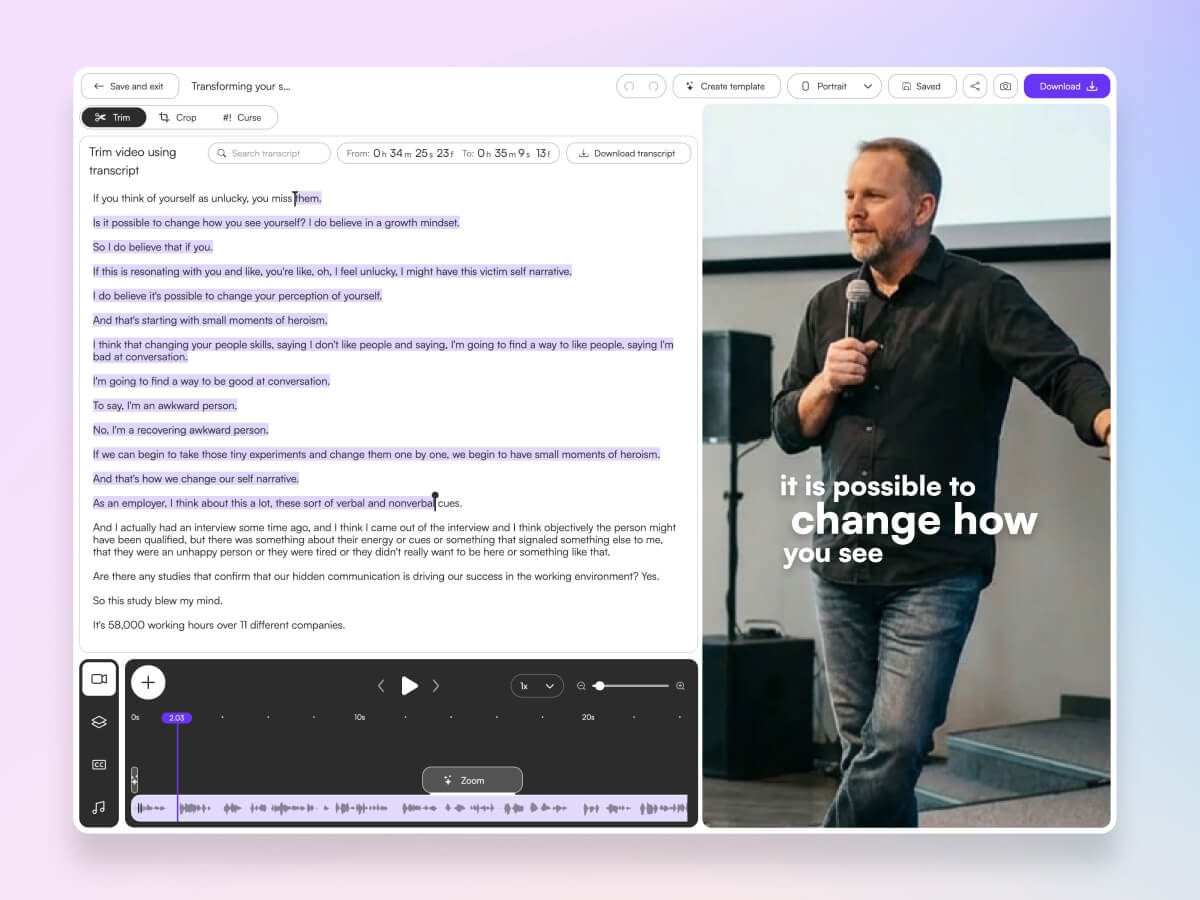
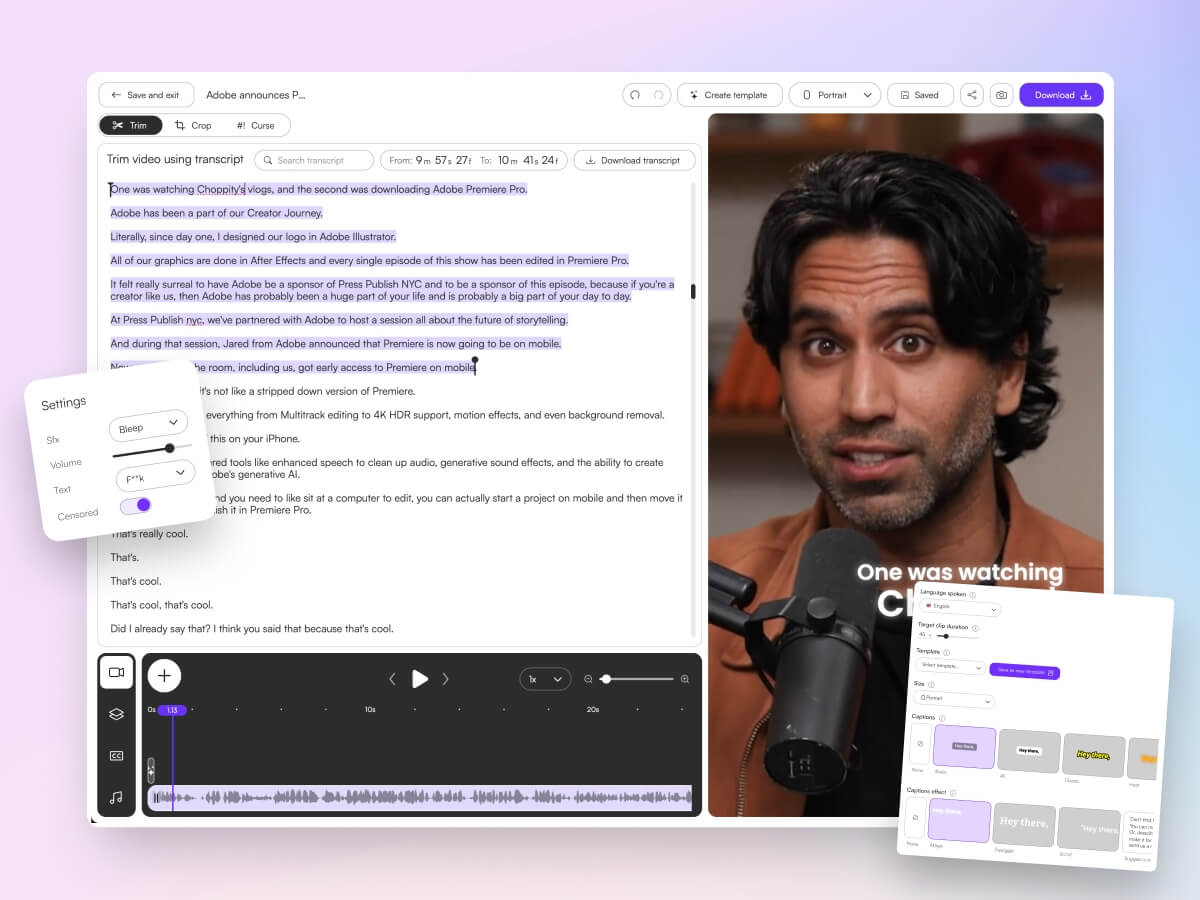
Podcasters don't need Premiere skills. Choppity's transcript-native editor lets you trim, cut, and censor by highlighting text — the video updates automatically. Word-level karaoke captions sync to the speaker in real time, and you can add B-roll, music, and effects from the same browser tab.
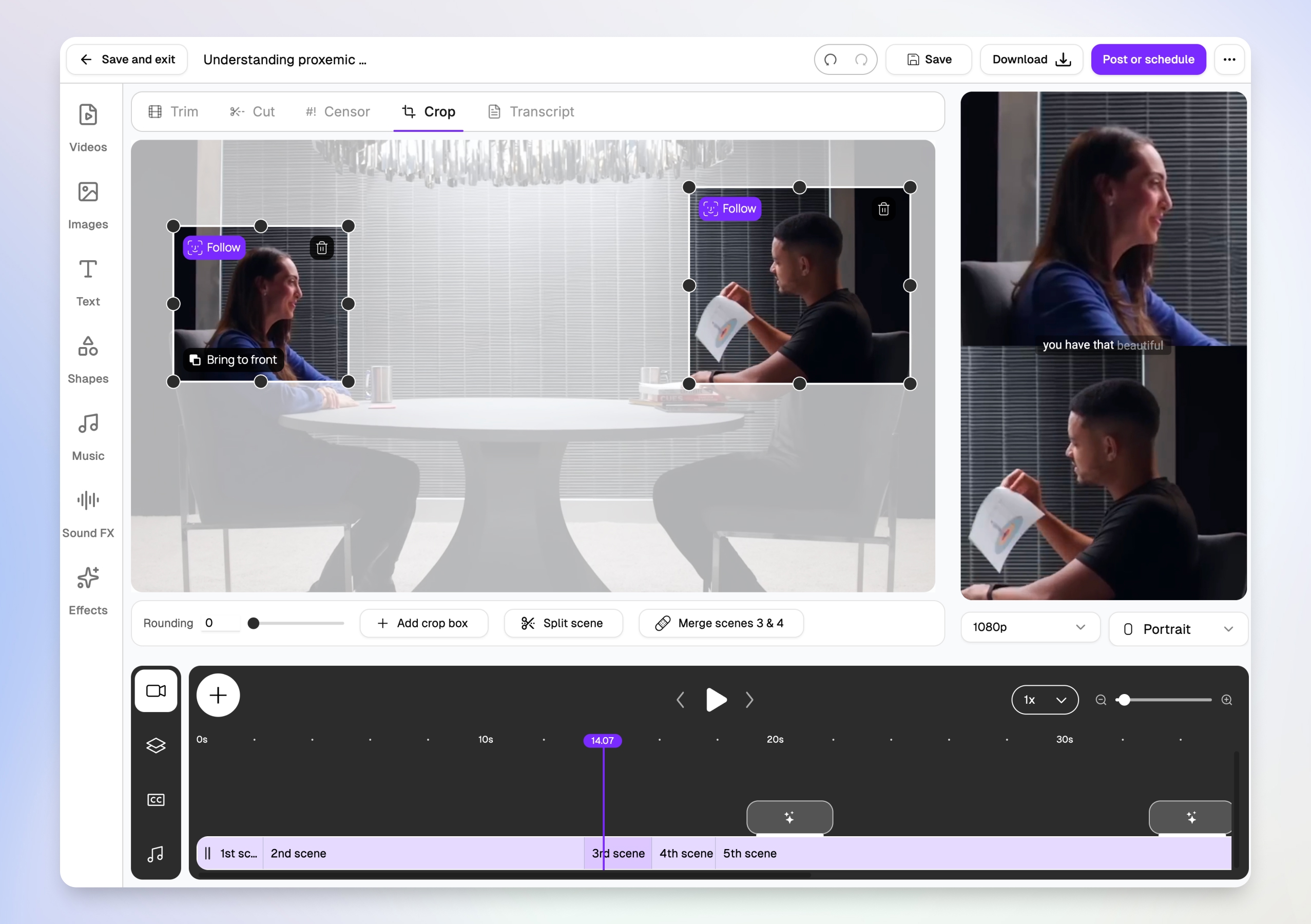
Multi-speaker face tracking for interview podcasts
Two-person interview podcasts are brutal to crop manually. Choppity's magic reframe follows each speaker with Follow tracking boxes, then outputs stacked split-screen layouts for TikTok, Reels, and Shorts — so both host and guest stay visible in vertical 9:16 without hours of keyframing.
Post or schedule to every platform from one modal
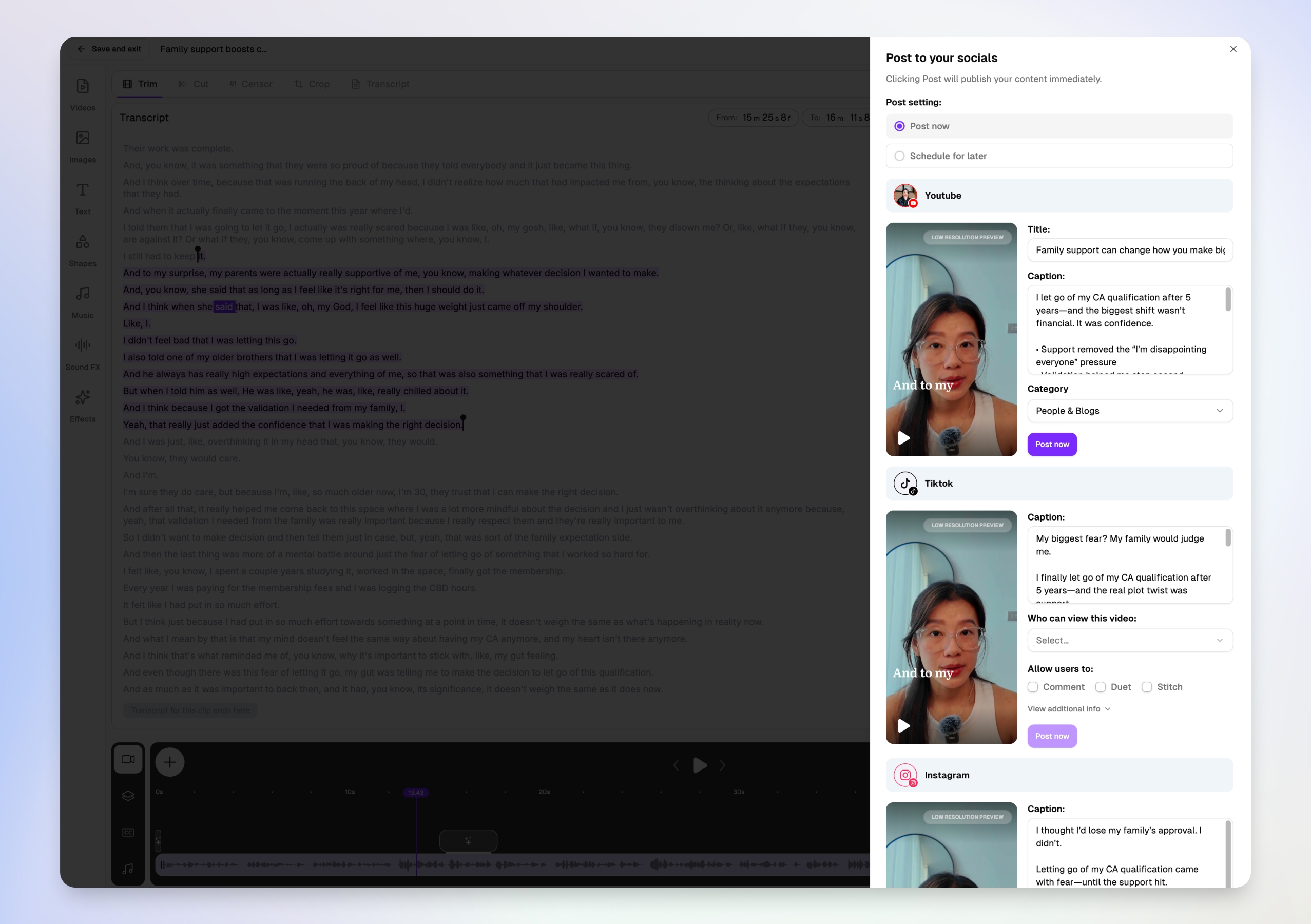
Downloading MP4s and re-uploading to five apps is where podcast repurposing dies. Choppity's Post to your socials modal lets you write platform-specific titles and captions for YouTube Shorts, TikTok, and Instagram in one view — then post now or schedule for later without leaving the editor.
More than a clip maker — full create → publish → measure loop
Competitors like Opus Clip and Riverside excel at one step. Choppity covers the cycle podcasters otherwise stitch together with 3–4 subscriptions:
- Transcript-native editor — trim, cut, semantic search ("find the part where the guest explains…"), profanity censor, B-roll, music, and 20+ caption styles with CFX effects
- Native posting & scheduling — per-platform captions, scheduled posts, and reconnect flows for expired OAuth
- Analytics dashboard — impressions, likes, comments, shares across posted clips
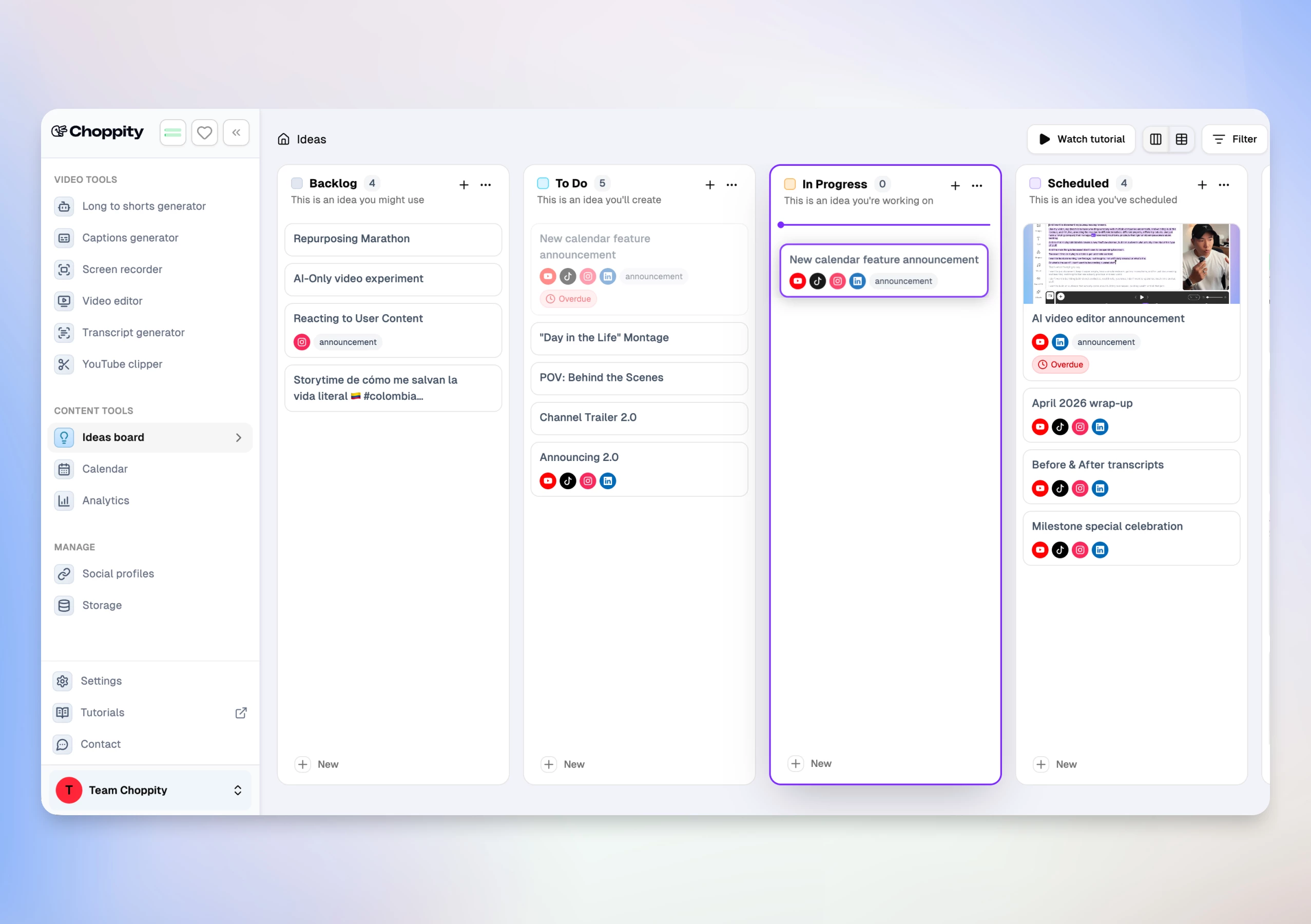
- Ideas Board + Calendar — Kanban from episode idea → clip → published post, integrated with clip folders
Real Use Case
A business podcast host uploaded one 60-minute interview and received 16 clip suggestions in under 12 minutes. After setting custom criteria for "highlight key insights," they scheduled a week of TikTok and Shorts posts without leaving Choppity — a workflow that took 5+ hours across Opus Clip + CapCut + manual uploads in our parallel test.
Here are real podcast clips created with Choppity:
Pros
- Fastest end-to-end workflow — analysis, edit, post, and analytics in one product
- Custom AI criteria tuned for conversational podcast content
- Clip picker with engagement scores and transcript previews — decide what to post before you edit
- Multi-speaker face tracking with stacked split-screen layouts for interview and co-host formats
- Transcript-native editing (trim, cut, censor, semantic search) — rare in clip-only tools
- Magic reframe with Follow tracking for 9:16, 1:1, and 16:9 output
- Per-platform titles and captions in one post-or-schedule modal (YouTube, TikTok, Instagram)
- 20+ caption presets plus CFX dynamic effects and word-level karaoke
- 97-language transcription and caption pipeline
- Native posting to YouTube, TikTok, Instagram, and LinkedIn
- Cross-platform analytics and Ideas Board for team planning
- Profanity filter and filler-word cleanup in the Cut workspace
Cons
- Free tier is preview-only — no downloads or full AI features until Starter ($20/mo)
- Less ideal for audio-only podcasts without any video element
- Maximum upload 120 minutes / 10 GB (sufficient for most podcast episodes)
Opus Clip
Opus Clip is the most recognized name in AI clipping. Podcast-focused SERP articles rank it #1 or #2 for virality scoring and hands-off clip volume. It analyzes speech, visuals, and pacing to assign a Clip Score — useful for sorting 20+ suggestions when you need to post fast after every episode drop.

Pros
- Strong virality / Clip Score for prioritizing what to post first
- Fast, mostly hands-off workflow — minimal decisions after upload
- AI B-roll generation on Pro plans
- Good talking-head accuracy for solo and interview podcasts
Cons
- Limited post-generation editing compared to Choppity's transcript-native NLE
- Can miss subtle conversational hooks that need context
- No cross-platform analytics or content planning board
- Watermark on free tier; scheduling gated to higher plans
Considering a switch? See our Choppity vs Opus Clip comparison.
Descript
Descript pioneered text-based podcast editing — delete a word in the transcript and the audio/video cuts. It's the industry standard for precision podcast production, but AI clip generation requires more manual selection than dedicated clippers.

Pros
- Best-in-class transcript editing and filler word removal for podcasts
- Screen recording, overdub, and full timeline for complex productions
- Excellent for teams that edit long-form before clipping
Cons
- Not a one-click clip maker — more manual than Opus Clip or Choppity
- No native social posting or scheduling
- Steeper learning curve for podcasters who only need shorts
Vizard
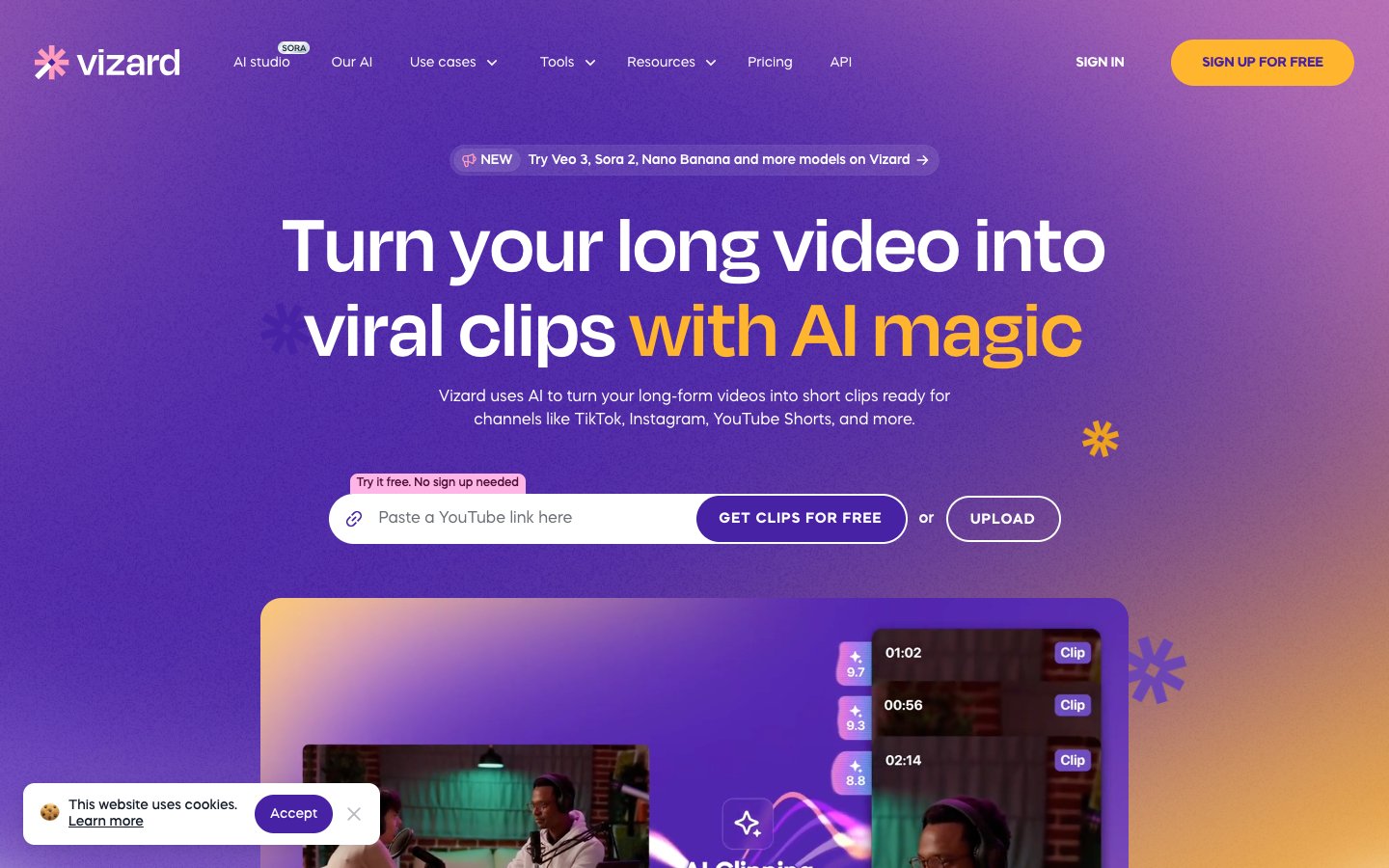
Vizard targets podcast teams that need fast browser-based clipping with brand kits and collaboration. It's ranked highly for interview-style podcast content and multi-seat workflows.
Pros
- Fast processing — under 5 minutes for 60-minute episodes in benchmarks
- Brand kits and team collaboration for podcast networks
- 100+ language transcription support
Cons
- Less depth in post-clip editing than Choppity or Descript
- General-purpose AI can miss nuanced conversational hooks
- No Ideas Board or cross-platform analytics
Considering a switch? See our Choppity vs Vizard comparison.
Klap
Klap positions itself as the premium visual option for podcast clips — cleaner crops, 4K exports, and brand-consistent output for shows that care about on-brand social presence.
Pros
- Polished visual output and 4K exports on Pro
- Strong speaker tracking and brand template controls
- Good for podcast networks prioritizing aesthetic consistency
Cons
- Fewer clips per episode than Opus Clip at the same price tier ($29/mo for ~10 uploads)
- No native multi-platform scheduling or analytics dashboard
- Less emphasis on transcript-native deep editing
Submagic
Submagic leads SERP "best for captions" picks. It's exceptional at animated subtitle effects for podcast clips — but weak at automatically finding the best moments in hour-long episodes without manual trimming first.

Pros
- Outstanding caption animations and emoji styling for TikTok-native podcast clips
- Fast workflow once you have a trimmed segment
- Good aesthetic out of the box for short-form podcast content
Cons
- Weak long-form moment detection — often needs manual segment selection
- No full NLE, analytics, or content planning
- Caption-first tool, not a complete podcast repurposing platform
Considering a switch? See our Choppity vs Submagic comparison.
Kapwing
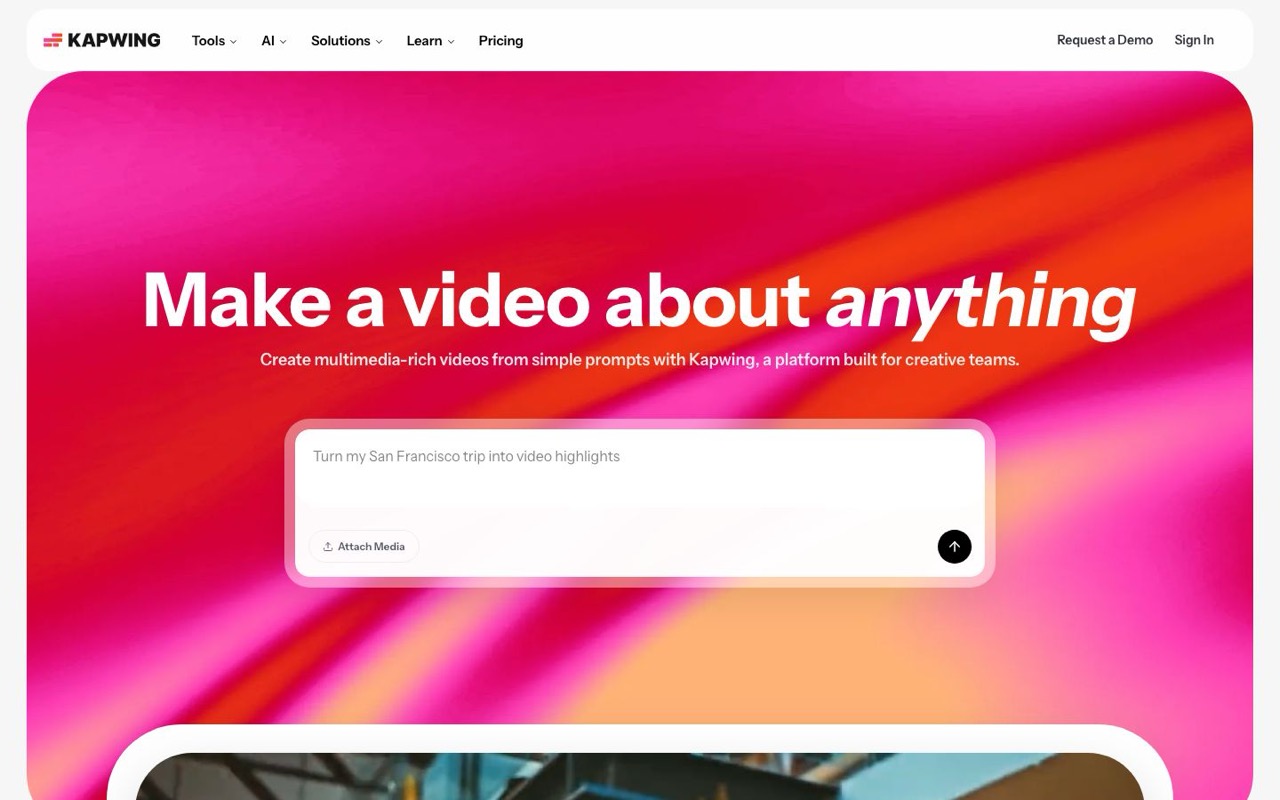
Kapwing is the strongest free starting point for podcast teams on a budget. Browser-based AI clip detection, filler word removal, and 100+ language translation — with collaborative workspaces for small podcast crews.
Pros
- Generous free tier — no credit card to start
- AI highlight detection plus manual editor in one browser tab
- Brand kit templates and team workspaces for podcast networks
Cons
- Watermark on free exports
- Less context-aware AI than Choppity for multi-topic episodes
- No native cross-platform analytics
Riverside
Riverside combines remote podcast recording with Magic Clips AI. Reviewers often recommend it when you want record → clip in one platform — though clip quality trails dedicated clippers.

Pros
- 4K remote recording with separate audio tracks per guest
- Magic Clips built into the recording workflow
- Strong for podcasters who record and repurpose in one tool
Cons
- AI clip selection less sophisticated than Choppity or Opus Clip
- Expensive if you only need clipping, not recording
- No Ideas Board, deep transcript editor, or cross-platform analytics
Vidyo.ai
Vidyo.ai focuses on marketing teams repurposing podcast and thought-leadership content into social snippets.

Pros
- Straightforward UI for non-editors on podcast marketing teams
- Social scheduling integrations
- Good for business podcasts with regular episode drops
Cons
- Higher starting price with fewer editing controls
- Limited caption customization vs Choppity's 20+ presets
- Weaker multi-speaker handling in our test
Considering a switch? See our Choppity vs Vidyo comparison.
CapCut
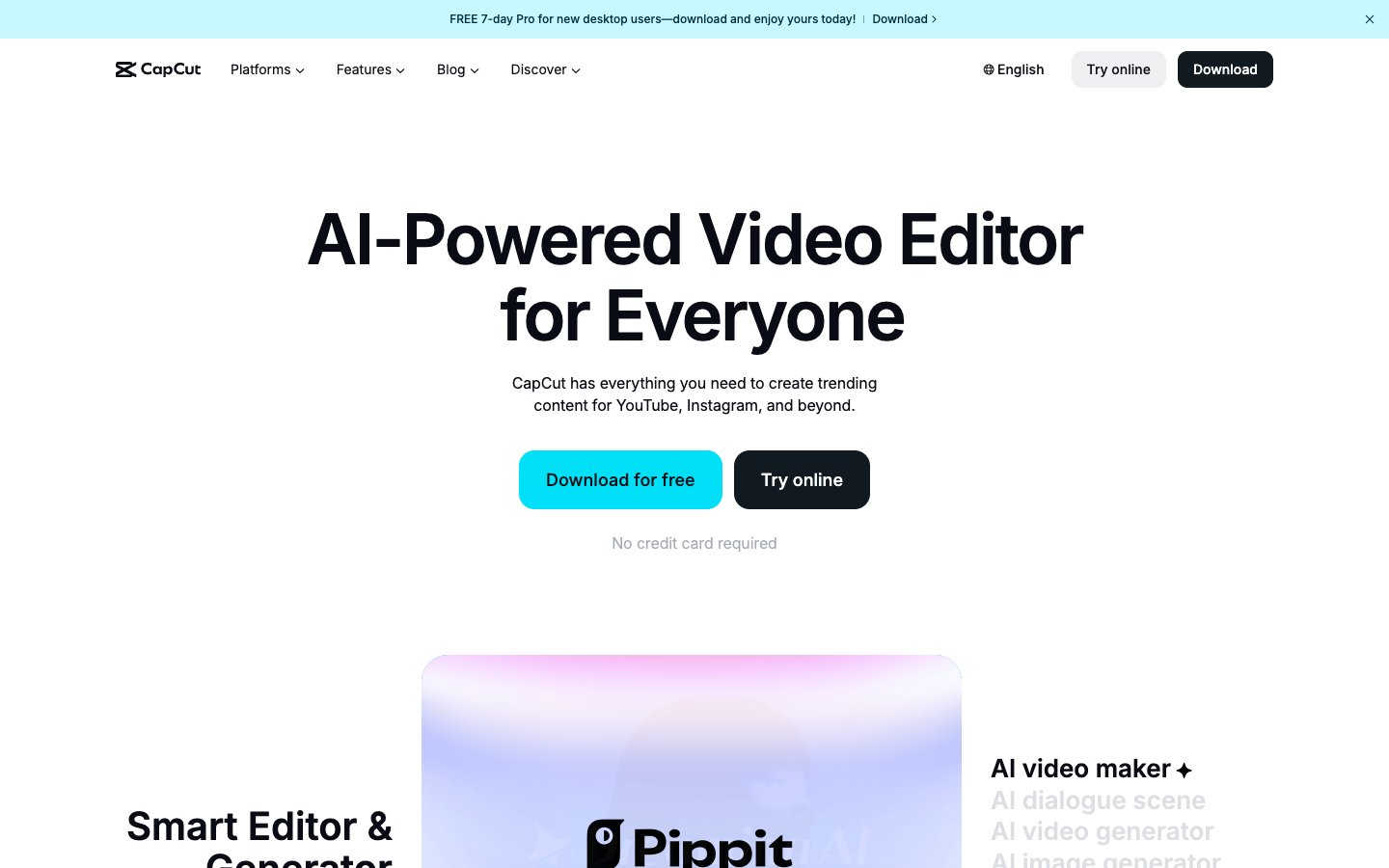
CapCut is the best free manual editor for new podcasters — full timeline, templates, and effects with no watermark. It has no AI moment detection for long-form episodes, so expect hours of scrubbing.
Pros
- Completely free with no watermark on exports
- Massive template library and effects for podcast clips
- Full manual control for creators who enjoy editing
Cons
- No AI clip detection from long-form episode uploads
- No native analytics, scheduling, or team planning
- Time-intensive for weekly episode repurposing at scale
Repurpose.io
Repurpose.io automates distribution — once podcast clips exist, it pushes them across platforms via RSS and workflows. It does not identify moments in your source episode.

Pros
- Excellent multi-platform distribution automation for podcast RSS feeds
- Strong analytics for cross-channel tracking
- Saves hours on the upload-and-caption grind after clips are made
Cons
- Zero AI clip detection — requires another tool upstream
- No editing, captions, or reframing built in
- Best as an add-on, not a standalone podcast clip maker
Head-to-Head Comparison
Side-by-side on the features that matter for turning podcast episodes into daily shorts.
| Tool | AI clip detection | Transcript editor | Multi-speaker tracking | Native posting | Analytics | Custom AI criteria | Best for |
|---|---|---|---|---|---|---|---|
| Choppity | Excellent | Yes | Yes | Yes | Yes | Yes | Full episode → clip → post → analytics workflow |
| Opus Clip | Good | Limited | Yes | Limited | No | No | Hands-off viral scoring from long episodes |
| Descript | Manual | Yes | Basic | No | No | No | Text-based podcast editing before clipping |
| Vizard | Good | Basic | Yes | Yes | No | No | Fast team clipping for interview podcasts |
| Klap | Good | Yes | Yes | No | No | No | Polished brand-consistent podcast visuals |
| Submagic | Poor | No | Basic | Yes | No | No | Caption effects on pre-trimmed podcast clips |
| Kapwing | Good | Yes | Yes | Yes | No | No | Free browser editor for budget podcast teams |
| Riverside | Basic | Basic | Basic | No | No | No | Remote recording + Magic Clips in one platform |
| Vidyo.ai | Good | Basic | Yes | Yes | No | No | Marketing teams repurposing podcast episodes |
| CapCut | None | No | Manual | Yes | No | No | Free manual editing for new podcasters |
| Repurpose.io | None | No | No | Advanced | Yes | No | Auto-distributing finished podcast clips |
Pricing as of June 10, 2026 — verified on each tool's /pricing page (monthly billing, lowest paid plan). Free tiers include restrictions.
Pricing Comparison (2026)
What podcasters actually pay once you're ready to publish clips without a watermark:
| Tool | Free tier? | Paid from | Annual discount | What you get on paid |
|---|---|---|---|---|
| Choppity | Yes — preview AI, no downloads | $20/mo | Yes (~30% off annually) | Starter: 3 hrs upload/mo, AI clips, transcript editor, captions, posting, scheduling, analytics, Ideas Board |
| Opus Clip | Yes — watermark | $15/mo | Yes (~$14/mo annual) | Virality scoring, AI B-roll, team seats on Pro |
| Descript | Yes — limited | $24/mo | Yes (~35% off annually) | Hobbyist: filler removal, overdub, screen recording, full timeline |
| Vizard | Yes — watermark | $29/mo | Yes (~50% off annually) | Creator: 600 credits/mo, 4K export, brand kits, scheduling |
| Klap | Limited trial | $29/mo | Yes (~50% off annually) | Standard: 10 uploads/mo, 100 clips, HD export |
| Submagic | Yes — watermark | $19/mo | Yes (~41% off annually) | Starter: 15 videos/mo, premium caption effects, clip detection |
| Kapwing | Yes — watermark | $24/mo | Yes (~33% off annually) | Pro: no watermark, team collab, 4K exports |
| Riverside | Yes — limited | $29/mo | Yes (~17% off annually) | Pro: 4K recording, Magic Clips, 15 hrs multi-track/mo |
| Vidyo.ai | Yes — limited | $29/mo | Yes (~50% off annually) | Lite: 100 credits/mo, 1080p exports, AI clips & captions |
| CapCut | Yes (fully free) | Free | N/A | Full editor — manual clipping only |
| Repurpose.io | No | $35/mo | Yes (~17% off annually) | Starter: 5,000 published videos/mo, 3 accounts per network |
Pricing as of June 10, 2026. All "Paid from" prices are monthly billing on each tool's lowest paid tier.
How to Choose an AI Clip Maker for Podcasters
Episode format fit
Solo shows, co-host banter, and guest interviews each stress AI differently. Multi-speaker face tracking matters for video podcasts with two or more people on camera. Custom AI criteria help when your best moments aren't the loudest — thoughtful insights, guest revelations, and callback jokes often get missed by virality-only scoring.
Clip detection vs. full workflow
Getting 20 clip suggestions is table stakes. The bigger question is what happens after: transcript editing, brand templates, native posting, and analytics. Clip-only tools mean 2–3 more subscriptions. Choppity, Descript (for editing), and Kapwing (for free browser editing) cover more of the podcast growth pipeline than Opus Clip or Submagic alone.
Posting and analytics
Downloading MP4s and manually uploading to five platforms is where podcast repurposing workflows die. Native posting (Choppity, Vizard, Kapwing) and distribution automation (Repurpose.io) solve different parts of this. Only Choppity combines posting, scheduling, and per-post analytics in the same product as clip generation.
Budget and team size
Solo podcasters on a tight budget should start with Kapwing's free tier or CapCut for manual work. Podcast networks with weekly episode drops need volume, team seats, and scheduling — where Choppity's Starter ($20/mo) or Riverside's record-and-clip bundle may fit. Repurpose.io is an add-on for distribution, not a clip maker.
Frequently Asked Questions
What is an AI clip maker for podcasters?
An AI clip maker for podcasters analyzes long episode video (or video podcast recordings) and automatically suggests short segments for TikTok, Reels, and YouTube Shorts. The AI transcribes dialogue, scores moments for engagement potential, and formats clips with captions and vertical reframing. Advanced tools like Choppity also include editing, posting, and analytics in the same platform.
What is the best AI clip maker for podcasters in 2026?
Based on our head-to-head testing with identical 60-minute podcast footage, Choppity is the best AI clip maker for podcasters in 2026. It's the only tool we tested that covers AI clip detection with custom criteria, transcript-native editing, multi-speaker face tracking, native multi-platform posting, scheduling, and cross-platform analytics without switching tools. Opus Clip is the best alternative if you want fully hands-off virality scoring and don't need deep editing or analytics.
Is there a free AI clip maker for podcasts?
Yes. Kapwing offers the strongest free tier for AI-assisted clipping (watermarked exports). CapCut is completely free but requires manual clip selection — no AI moment detection. Choppity and Opus Clip offer free previews so you can test AI accuracy on your episode before upgrading to a paid plan.
Choppity vs Opus Clip for podcasts — which is better?
Opus Clip wins on hands-off virality scoring and clip volume with minimal decisions after each episode drop. Choppity wins on the full workflow: custom AI criteria for conversational content, transcript-native editing, multi-speaker tracking, native posting/scheduling, Ideas Board planning, and analytics. Choose Opus Clip for speed-only clipping; choose Choppity if you want one tool from upload to published post.
Can AI clip makers handle multi-speaker podcast episodes?
Yes — but quality varies. Choppity and Opus Clip both track multiple speakers in video podcasts. Descript handles multi-speaker transcripts well for editing but requires manual clip selection. Submagic and Repurpose.io don't analyze full episodes for highlights. Test with your actual episode format before committing.
How long does AI clipping take for a 60-minute podcast episode?
For a 60-minute episode, expect 5–15 minutes on Choppity, Opus Clip, and Vizard. Descript and CapCut depend on how much manual work you add. Riverside varies based on whether you're recording first or clipping an existing file.
Do AI clip makers work for audio-only podcasts?
Most AI clip makers on this list require video input for face tracking and vertical reframing. Audio-only podcasters typically need to add a static image or waveform video first, or use audiogram tools like Kapwing. Choppity works best with video podcast recordings; for audio-only, see our podcast clip maker guide for audiogram workflows.
Which AI clip maker has the best captions for podcast clips?
Submagic leads on pure caption animation aesthetics. Choppity offers 20+ caption presets plus CFX dynamic effects, word-level karaoke, and 97-language support — the best balance of style and multi-speaker transcription accuracy in our test.
Can I clip podcast episodes from YouTube links?
Yes. Choppity, Opus Clip, Vizard, and several others accept YouTube URL import — paste your episode video link without downloading first. This is ideal for podcasters who publish video versions on YouTube. Try it free with the Podcast Clip Generator.
What's the difference between this guide and your podcast clip maker comparison?
This article targets the keyword "best AI clip maker for podcasters" with the same 11-tool test as our general clip maker roundup, optimized for podcasters evaluating all major options. Our best AI podcast clip makers guide goes deeper on podcast-specific features like audiograms, episode-length processing, and Castmagic for show notes.
The Verdict
After comparing 11 AI clip makers in this roundup, the market splits into three tiers: clip-only tools (Opus Clip, Vizard, Submagic), editing-first tools (Descript, CapCut), and full-workflow platforms (Choppity). SERP articles overwhelmingly recommend Opus Clip for virality or Riverside for record-and-clip — valid picks if clipping is your only step.
If you need one tool from episode upload to published shorts with analytics, Choppity is the clear winner for podcasters. Custom AI criteria, multi-speaker tracking, transcript-native editing, magic reframe, native posting, and cross-platform analytics put it in a different category than clip generators that hand you watermarked MP4s.
For the full podcast-specific deep dive, read our best AI podcast clip makers comparison. Ready to test with your own episode? Use the Podcast Clip Generator or start free below.






Written by
Michael WongFounder & CEO · Founder of Choppity
Content creator for 12+ years with 215K+ YouTube subscribers and an active presence across YouTube, Instagram, LinkedIn, and X. As founder of Choppity, Michael has personally tested every major AI clip maker — giving him a unique perspective on what works and what doesn't for real creators.