


01Meet Unscripted with Raygan
Founder conversations that deserve to travel beyond the full episode
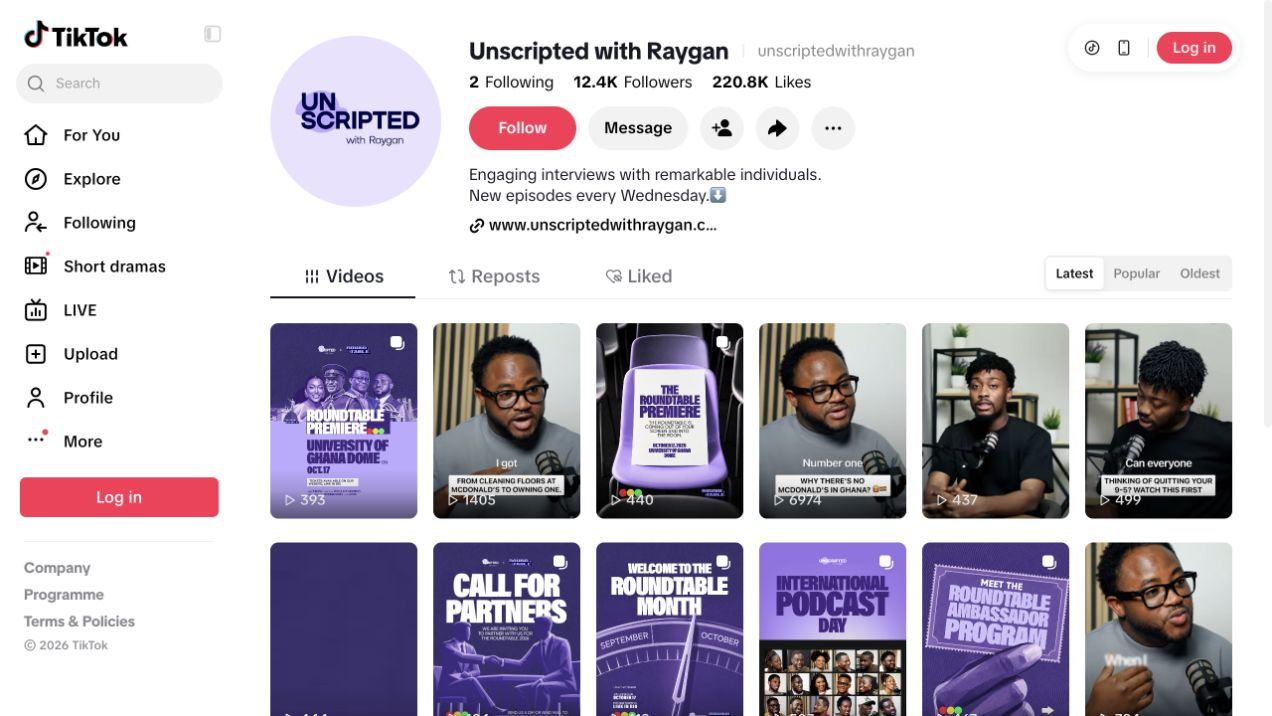
Unscripted with Raygan goes into the details behind building a business: money, visas, small rooms, and wins that took work. Reagan Marfo interviews founders and builders in Africa and beyond about what that journey really involved.
Young listeners come for stories that feel possible for them. The long interviews give those stories room to unfold, while short clips offer people on Instagram and TikTok a way into the conversation.
Keeping both formats moving created a second production job for the team. Every finished episode still needed someone to find the moments worth sharing.
 View full size
 View full size
 View full size
02The time problem
Why manually finding podcast clips slowed the whole team down
Before Choppity, the team watched entire episodes and wrote timestamps by hand before opening their editing software. Strong moments could land late in a conversation, just as fatigue and distractions started to build.
On busy weeks, fewer timestamps meant fewer finished clips. Full episodes still went out, but Instagram and TikTok became quieter. The search for useful moments was taking time away from making them ready to publish.
The hardest part was spending hours watching long videos just to find clips we could use. It was slow, and it slowed everything else down.
03Finding the right tool
An AI podcast clipper that gives editors a useful starting point
With Magic Clips, the team uploads an episode and gets suggested timestamps and clips. Editors can start by reviewing those suggestions instead of watching and rewinding the whole recording to build a list from zero.
The team still drops roughly half of the suggestions because pacing matters. Choppity helps with discovery; the editors decide which moments deserve the final polish.
That shift made the same working time go further. They began publishing about three times as many shorts per week once less of the process depended on finding every moment by hand.
The first time we used the AI Magic Clips feature, our reaction was simple: 'Where has this been all our lives?'
04The repeatable workflow
From a long interview to clips ready for Instagram and TikTok
Choppity now sits at the start of the clipping routine, after the episode is uploaded. The microphones and studio stay the same, while the team spends more of its editing time on the clips it wants to keep.
-
Upload the episode
Bring the recording into Choppity and use Magic Clips to suggest moments and timestamps.
-
Choose the strongest moments
Review the suggestions, keeping the clips that have the right pacing for the show.
-
Trim and refine
Adjust the chosen clips and fill in captions where the audio is unclear.
-
Preview for each platform
Check Instagram and TikTok previews as part of the same workflow, without repeatedly reloading the master file.
 View full size
05The results
Three times the clip output, with 20.4K+ tracked social views
Compared with their earlier manual process, the team reports publishing about three times as many shorts each week.
The tracked batches of clips generated with Choppity before final edits recorded 11,108 Instagram views and 9,347 TikTok views, a combined 20,455 views across the two platforms.
The supplied screenshots below also show individual clips performing on YouTube and Instagram. They provide examples of how the clips travelled, alongside the reported change in output.
The view totals are a snapshot of the tracked clips, with no shared reporting period specified. For the team, the clearest operational result is a steadier flow of short-form content from the conversations they are already recording.
Inside the analytics
Swipe to explore View full size
Screenshot 01
- Studio shows about 1.9K views since this Short published.
- Performance sits roughly one thousand incremental views above usual versus similar Shorts.
- Average watch duration exceeds the clip (131% of runtime), signals replays or people sticking past the opener.
- Replay-friendly pacing is exactly the behavior short-form feeds tend to amplify.
 View full size
Screenshot 02
- Interview beat with Julian (“Why you shouldn’t rely…”).
- YouTube calls this Short 21% higher than the channel’s other Shorts.
- 932 views logged in-period, labelled 162 more views than usual.
- Average duration near 19 seconds at about 48.5% retention.
 View full size
Screenshot 03
- Negotiation-themed Short; multi-month trajectory in analytics.
- Roughly 1,121 views, 241 more than usual for comparable Shorts.
- About half the audience still watching (~50%) with ~31s engaged on average.
 View full size
Screenshot 04
- Clip “Leadership is more than just a title!” on native short-format insights.
- 2,316 plays and north of three cumulative watch hours.
- Solid interaction stack: likes, comments, reshares/reposts, saves, not just passive views.
 View full size
Screenshot 05
- Short “Start a business without capita…”: about 1.1K plays.
- 239 more views than usual on the baseline band.
- Two new subscribers attributed directly.
- Strong hold: ~nine-tenths of average duration (~51s) vs runtime.
 View full size
Screenshot 06
- Moment featuring Kwadwo Sheldon.
- Studio headline: roughly 3.2× typical Short views on this channel.
- About 2.3K lifetime views (~1.6K above usual) inside the shown window.
- ~82% retention, ~38s average watched, intrigue held past hook.
 View full size
Screenshot 07
- Reels insights “Building confidence…” on a tight 20s cut.
- 735 views logged for that reel.
- Shares/remix totals show framing that travels in-feed even when comments stay light.
- Demonstrates podcast moments cut into native Reels pacing.
 View full size
Screenshot 08
- Edgier monetization take: “You don’t deserve to be monetized.”
- 5.5K+ reel plays, triple-digit likes, healthy repost/save traction.
- Insight-level watch time clears a full cumulative day for that reel.
- High interactions (~hundreds) relative to softer promo-style cuts.
06The next chapter
Keeping full episodes at the centre of a podcast growth strategy
Long conversations still come first. The show continues to make room for founders with real experiences to share, including guests who rarely post on social media. Listeners can contribute rough voice notes too.
Clipping gives those conversations more ways to reach people. For the team, returning to the old routine would mean more time spent searching recordings and a slower flow of posts. A repeatable clipping process supports the work they want to keep making.